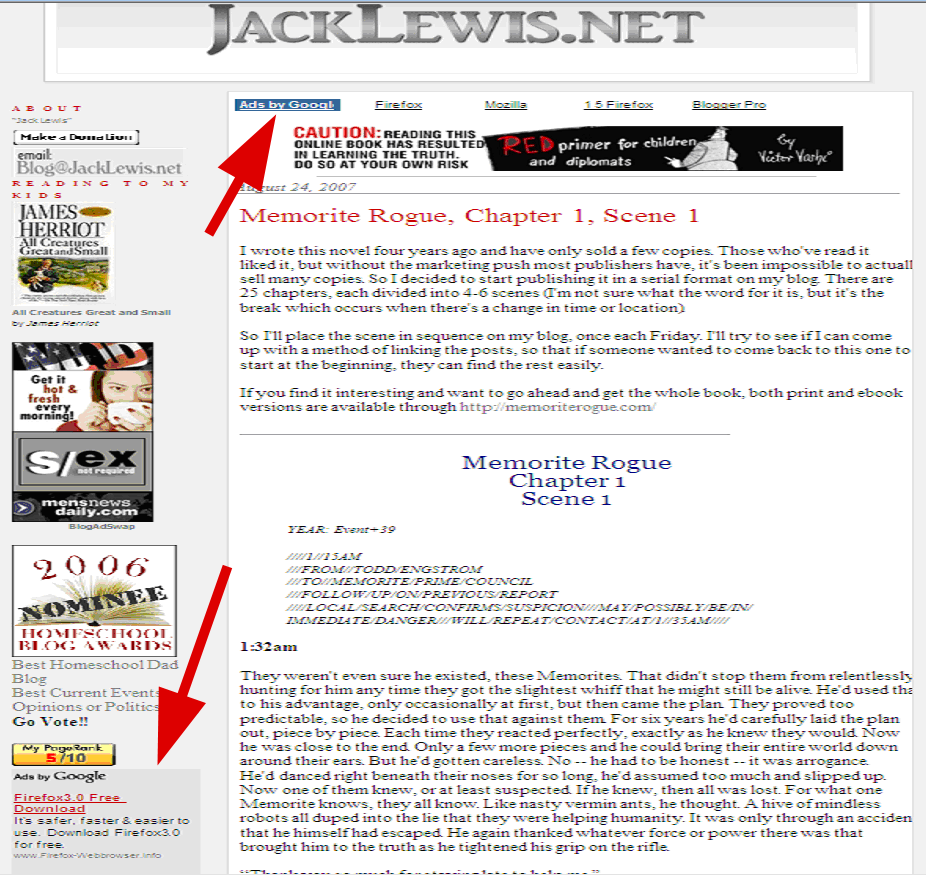
So it is Friday…and I was a little bored at work (and happened to be following up on this blocking of Firefox business since I brought it up at the afternoon coffee ‘break’). Before I get too far into this, there’s a point to the picture in this post — I’ll get to that toward the end of the post.
Anyway, I came across a fantastic rebuttal to the blocking of Firefox traffic and needed to share it with the world myself. If you scroll down far enough into the comments, you’ll actually see stuff written in rebuttal (to the rebuttal) by the original creator (of the blocked Firefox site).
Admittedly, I have to give the guy (Firefox blocker) a little bit of credit, if for nothing else than putting up with a load of rants, flames, and rebuttals about his tactics. He’s obviously quite opinionated about this topic. That doesn’t mean I agree with him (quite the opposite); in fact I think he’s quite an idiot. He’s going about this all wrong and puts far too much value in his content, which apparently in his eyes is so enthralling that even a ‘minor financial hit’ (to paraphrase) in blocking the Firefox user agent is worthwhile.
I also think he’s got quite a few facts and definitions wrong. I don’t agree with some of the apparent flamers that have reportedly threatened him — that is most definitely wrong — but I also don’t agree with his own implied opinion that Microsoft software (IE in particular) is inherently a superior product and everything else (Firefox in particular) is inferior (especially if its parent company supports an ad blocking software company). Does that make me ignorant or an anti-Microsoft ‘nazi?’ No.
I can respect Microsoft for its products and positions. I use various Microsoft applications every day. Even Internet Explorer (although admittedly only as often as absolutely necessary). But, I’m sure (just as he raises issue with Mozilla and the Ad Block people) there are corporate partnerships or associations which Microsoft has made that are equally as nasty. The point is simply thus: this dude has a problem. What that problem is seems not to be well-defined.
- He views Mozilla and (specifically) Firefox as ‘religious organizations.’
- He views the Mozilla – AdBlock partnership as inappropriate (since AdBlock apparently comes with Firefox).
- He views his content to be so important that any ad revenue loss by blocking a user agent is wholly worthwhile, even if the very act prevents his all-important content from reaching the end user.
- He has a problem with following W3C standards.
- He doesn’t seem to have a solid grasp that, when using special ‘non-standardized’ functionality exclusive or limited to IE, things don’t magically work the way he expects in a standards-compliant browser such as Firefox (because it ignores the crap).
- He thinks ad blocking is theft, links theft to being an anti-Christian value, and implies in various ways that any thief or supporter of theft is automatically a socialist with anti-Christian tendencies.
- He states “Wikipedia is socialist.”
There is a significant amount of flip-flopping of subjects. This man is clearly on the defensive and seems to address one issue, then side-step to another. To be quite honest, I’ve read so many seemingly random arguments he’s made that I’m not honestly sure exactly what really lit the fire under his ass in the first place. Reason I say that is simply due to the fact that when he starts to explain his standpoint, he thrusts into another topic or point about his incredible dislike of Firefox. The one thing I read today which really pisses me off:
The useragent info in the header is the normal way, but there are also other methods, since FireFox follows W3C standards and won’t adopt standards based on market use, and other browser engines do.
My first thought is ‘If all your friends jumped off a bridge, would you do the same?’ Blindly following the ‘leader’ does not a good argument make. What the hell does market use have to do with document structure, presentation, and markup? The W3C doesn’t care about ‘market use’ per se. Quoted from the W3C About Page:
In order for the Web to reach its full potential, the most fundamental Web technologies must be compatible with one another and allow any hardware and software used to access the Web to work together. W3C refers to this goal as “Web interoperability.” By publishing open (non-proprietary) standards for Web languages and protocols, W3C seeks to avoid market fragmentation and thus Web fragmentation.
What exactly does this mean? It means that educated people with the intention of making the Web a better place follow things called standards which, in turn, mean that the experience is as similar as possible for every visitor, no matter what. If that means your damn DHTML doesn’t work in Firefox, so be it. Don’t use it. Find a better way (CSS layers?) to do it instead. Follow a standard — not a presentational hack.
I’ve really run out of time for this dude. If you’re bored and want to read some seriously flawed and heated debate, read a blog entry from JackLewis.net. Oh yeah, you’ll have to open that in IE, because (without changing the user agent) it won’t open in Firefox.
But, speaking of the aforementioned site, this brings me back to the picture for this post. I happened to be viewing the site in question, examining its content. You’ll note the two red arrows I placed on the screenshot. The first: 
The second: 
The ironic part of this is that, after all things are said and done, his all-precious advertising included TWO ads (through Google) for Firefox. One in particular (the sidebar one — the square one) wasn’t officially from Mozilla, and the top ad I’m not sure of the origin, but there was no humor lost on me with this one. I just find it incredibly ironic that a blog entry vehemently opposing Firefox usage due to the Ad Block business included two automatically-generated ads for Firefox.
Really serves him right if you ask me.
Ah well. I’d like to see him write his own browser software and see how fun it could be to implement all of the ‘W3C standards’ and ‘market use standards.’ I’ve never directly done it myself, but I worked with a few people in a course I took several years ago who implemented their own web browser. It’s not as great as it seems. Dear sir, there is a reason for standards.
Perhaps this will be my last post about this subject (I can hope), but I will likely keep an eye out for a while yet to see if there’s anything new. At this point in time it seems as though the horse has been dead for some time and nothing new is transpiring…so one can hope this brief interlude in our normal Internet activity will be nothing more than another tick mark in the timeline of ‘browser wars.’ Or at least I can hope for that.
“When ideas fail, words come in very handy.”
– Goethe (1749-1832)
–MZ